

In the Maldives, the reef is often where the real magic begins.
This year, Grand Park Kodhipparu, Maldives was recognised among the country’s finest, earning the distinction of being named #9 Best Resort House Reef in the Maldives by Travel + Leisure — a recognition that celebrates not just the beauty of our reef, but the way guests can experience it.
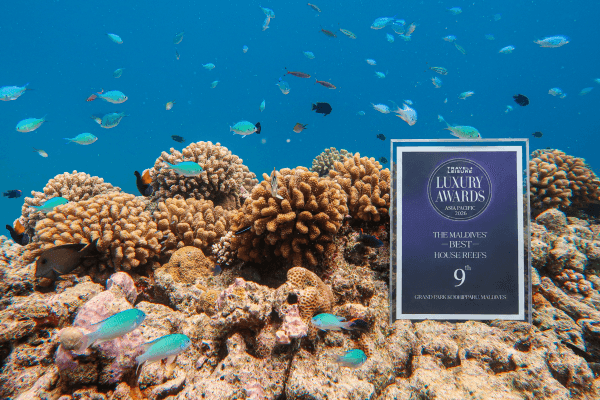
At Grand Park Kodhipparu, our house reef is not reserved only for experienced snorkellers or confident swimmers. It is one of the rare reefs in the Maldives designed by nature to be genuinely accessible.
From the beach, guests can simply walk into our calm turquoise lagoon, where shallow waters provide a natural and reassuring introduction to the ocean. From there, the reef edge is just a short swim away — making the transition from lagoon to living coral garden feel effortless and inviting.
For many, it is their first real encounter with the underwater world.
And importantly, it is not just for swimmers.
As our 2026 experience strategy recognises, many of today’s travellers — particularly from key Asian and GCC markets — are either non-swimmers or hesitant in the water, making accessibility and confidence-building essential parts of the guest journey.
At Grand Park Kodhipparu, this has shaped how we present the reef.
Our Marine Sports team offers guided snorkelling experiences tailored to all confidence levels, while flotation support and expert supervision make it possible even for first-timers to experience the extraordinary marine life below. For non-swimmers, glass-bottom kayaks, lagoon photography moments and guided marine discovery provide a way to connect with the reef without needing to dive beneath the surface.
For those staying in our Reef Pool Villas, the reef is even closer — just steps from your private deck.
And for guests in our Overwater Villas, the Indian Ocean becomes your front garden; slip directly into the lagoon and explore the reef from your villa staircase, where reef sharks, rays, turtles and schools of tropical fish are regular visitors.
But what makes our reef truly special is not only what exists today — it is what we are actively building for tomorrow.
At the heart of this work is our resident marine biologist, whose role extends far beyond guiding snorkeling excursions. Her knowledge changes the way guests experience the ocean, turning uncertainty into curiosity, and replacing old fears of sharks, rays and other reef creatures with genuine fascination. A shark sighting stops feeling like something to be afraid of and becomes one of the highlights from the trip.
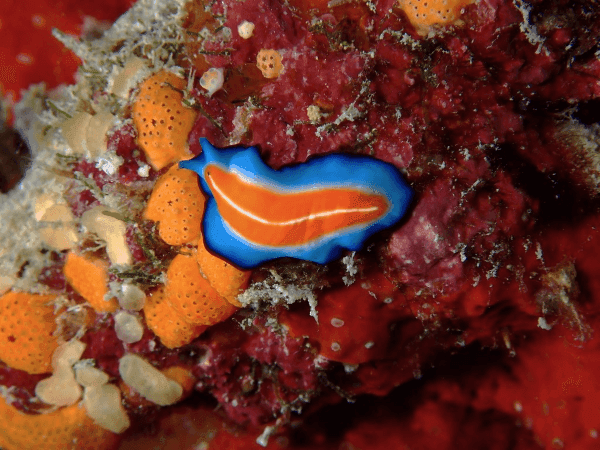
Every part of the reef, as it turns out, has its own character once you know where to look. The lagoon, calm enough for a child's first swim, also happens to be a favourite nesting ground for titan triggerfish, fiercely protective parents whose reputation precedes them, but whose behaviour, once explained, becomes something guests want to observe rather than avoid. Drift a little further out, and the coral gardens open an entirely different world: nudibranchs, feather stars, parrotfish in colours that look hand-painted, scattered across the rubble like jewels waiting to be found, while reef sharks and turtles move through the open water beyond with quiet, unhurried confidence.
It is this range, small and immense, hidden and obvious, that makes the reef feel like it has something for everyone. For underwater photographers especially, it is close to a playground: a single dive can take you from a macro lens slowly closing in on a nudibranch no bigger than a fingernail, to a wide-angle shot of a turtle gliding past a coral bouquet. Few reefs offer both extremes so generously, and fewer still let you find them within steps of the shore.
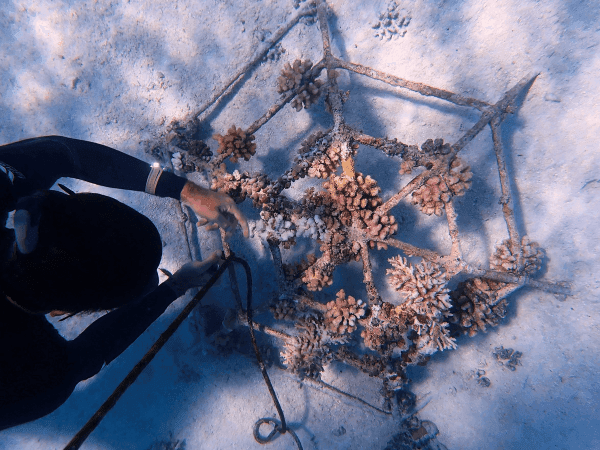
Through what we affectionately call “underwater gardening,” guests are invited to learn first-hand about coral propagation, reef regeneration and the delicate balance of marine ecosystems. Together with our team, she is developing a growing coral nursery — nurturing new coral fragments to strengthen reef resilience and support regeneration in the face of rising sea temperatures and increasingly unpredictable climate conditions.
This work has become even more important in recent years.
Across the Maldives, coral ecosystems continue to face challenges from warming waters and recurring El Niño–Southern Oscillation cycles, which place stress on fragile reef systems. At Grand Park Kodhipparu, our response is proactive: restoration, education, and conservation working hand in hand.
Coral reefs are resilient, but they are not invincible, and what happens to them next depends, in part, on choices we are making right now. We cannot control the warming seas. But we can control what we do about it: every fragment that takes root in our nursery is a small, deliberate act of protection for a reef that has given so much to so many. It is not a guarantee against what is coming. It is simply our way of giving this reef every possible chance to keep thriving — for the guests who will stand on this same beach in ten, twenty, fifty years.
Because luxury today is no longer only about where you stay.
It is about what you connect with.
At Grand Park Kodhipparu, our award-winning house reef offers more than marine beauty. It offers access. Discovery. Understanding. And the rare opportunity to become part of the reef’s future.
A stay here is not simply about seeing the Maldives.
It is about feeling connected to it — above and below the surface.
Grand Park Kodhipparu, Maldives.
Connected Island Luxury.